The ball stays in the player's hands: no basketball drawn through another body in the replay
In the 3-D replay, the ball a player carries used to be drawn in front of them, a little way ahead toward the basket. When a defender stood face to face, that spot was inside the defender, and the ball was drawn through their chest. Across three whole test games it happened in about 155 frames each. Now it happens in none while the ball is carried.
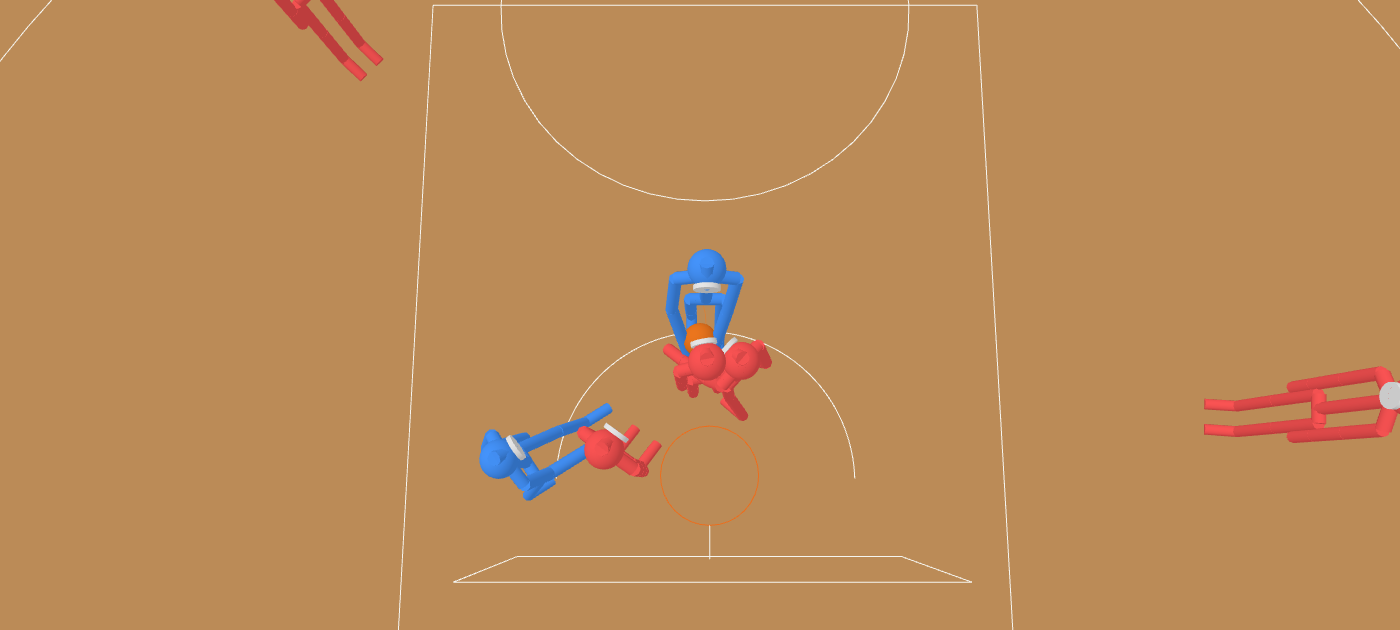
The ball moves round the player, not through the others
Where the ball sits around its holder is now a value that changes over time, not a fresh choice every frame. Sixty times a second the replay works out which directions around the holder would put the ball inside another body, and turns the ball out of them, by the nearer way. When the space opens again, the ball turns back toward the basket. A dribble's bounce starts and ends where the carried ball is, so it follows the same path.
The ball turns at most as fast as an arm can move it, about three metres a second at arm's length, and at most a quarter turn to either side, the reach of the arms beside the body. So a defender stepping in moves the ball aside within about a tenth of a second, turning it no faster than an arm could.
Because the ball's place is worked out from the game's own recorded positions, the same moment always looks the same: pausing, scrubbing back or playing straight through all show the ball in the same place.
When there is no room at all
Sometimes two or more players crowd the holder so closely that no direction is free. Then the ball stays where it was. Those moments are rare, a handful of frames in a game, and the check that runs over whole games counts them under their own name rather than letting them pass as fine.
One case is still open: when a player gathers to shoot and a teammate runs across the front of them, the rising ball can pass through that teammate for a frame or two. The same check names those moments too, two of them in a whole game.