A link to any view of the basketball replay
The replay's broadcast camera sits 20 to 25 metres from the play. From there a head is about 9 pixels tall and a hand about 4, so the plays decided by hands, like a steal, a strip or a player turning their head to look, are hard to see. And a view you found by flying the camera around could not be shown to anyone else. The address held only the moment, never the camera.
Now the link holds the camera too. Press L in the replay and it pauses, then writes the exact view you are looking at into the address bar. Anyone who opens that address sees the same moment from the same place.
Follow anyone, from anywhere
A link can follow the ball or any player by the name on their card, from an offset you choose. It can also put you behind a player's eyes. The camera is placed from the figure itself every frame, so it stays on them as they move:
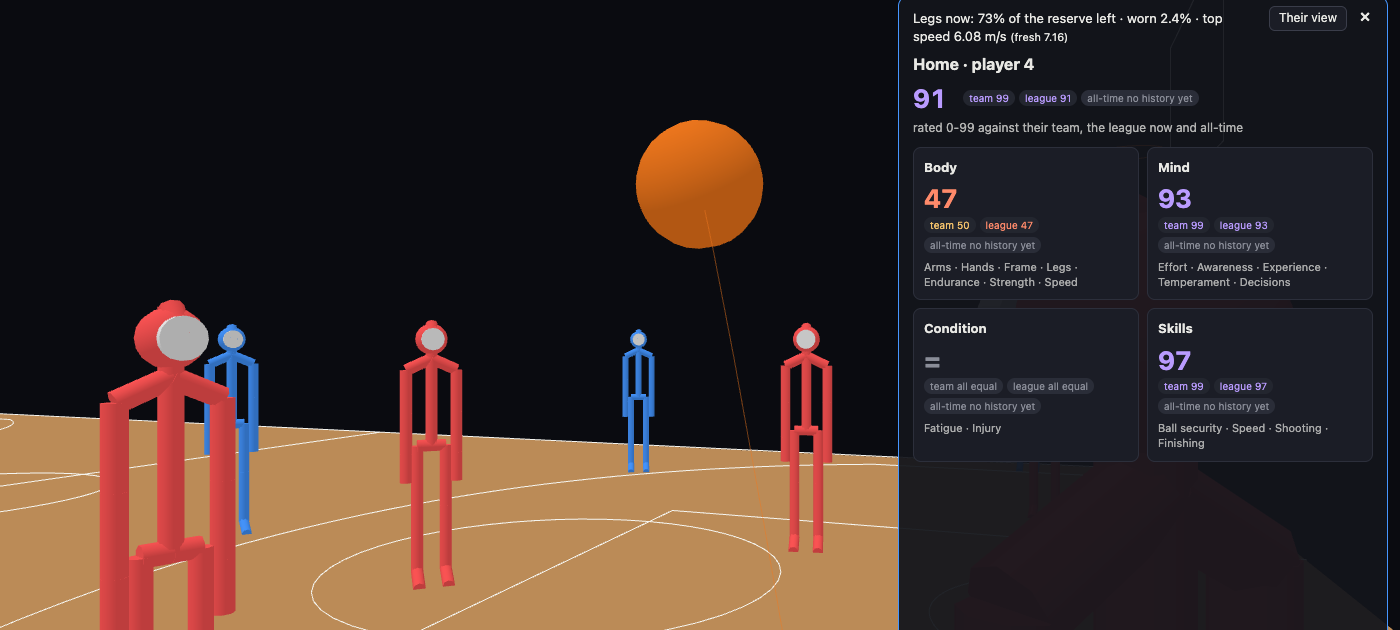
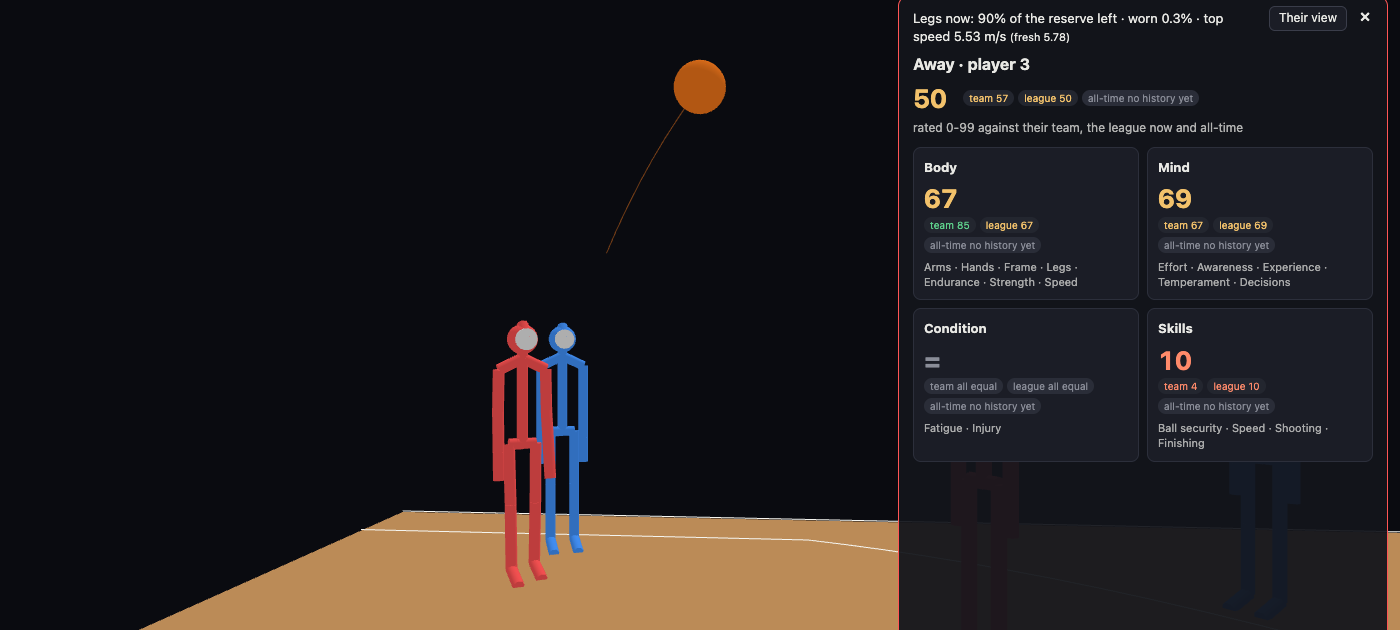
#t=586.1&follow=away3&from=3,0,1.2: at 9:46.1, beside away player 3, 3 metres off at chest height.#t=585.3&follow=home4&eye: at 9:45.3, through the eyes of home player 4.#t=586&follow=ball: at 9:46.0, 4 metres off the ball at eye height.
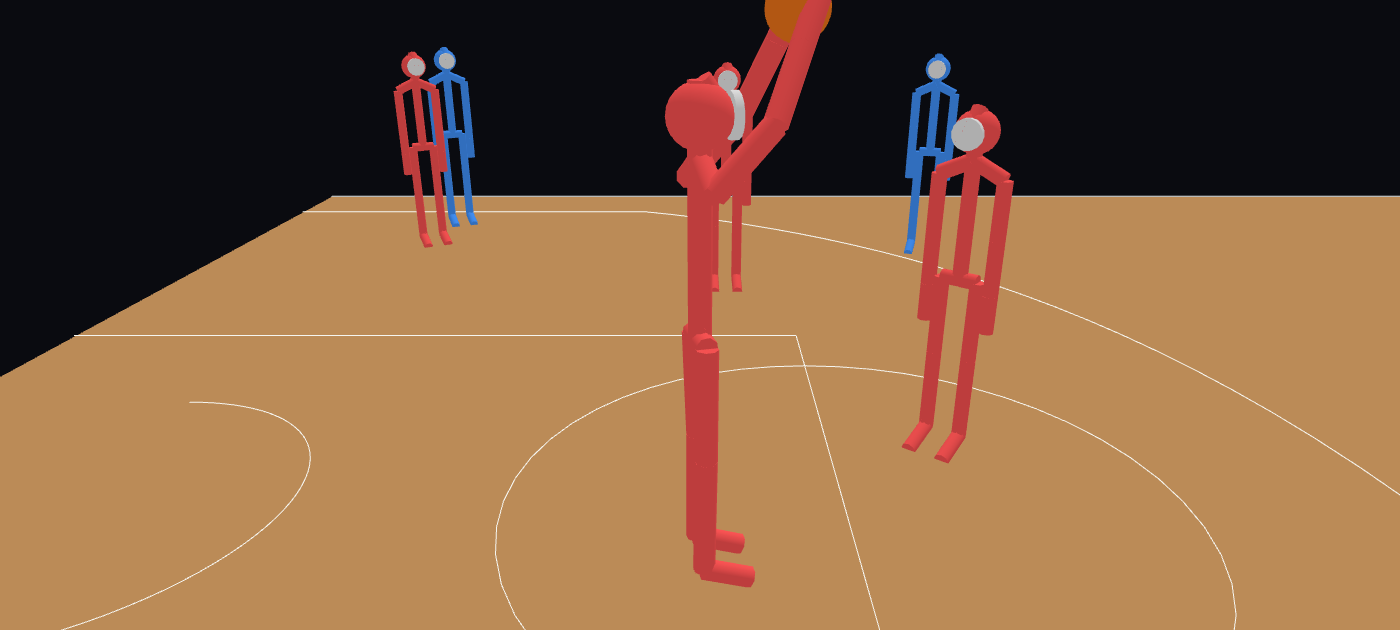
Here is one interception in a game of the league, seen three ways. First, the passer's own view as the ball leaves their hands, with their card open:
A link that writes itself back unchanged
One function writes every link, and one function reads it, so a view survives the round trip. Numbers are kept to the millimetre. A link opened fresh and shared again with L comes back exactly as it went out:
export function toHash(link, h) {
  const num = (...xs) => xs.map((x) => String(Number(x.toFixed(3)))).join(",");
  const name = (who) => { if (who === "ball") return who; const [side, j] = h.players[who]; return `${side ? "away" : "home"}${j + 1}`; };
  const parts = link.tr.playing ? [] : [`t=${num(link.tr.t)}`];
  if (link.cam) parts.push(`cam=${num(...link.cam.pos)}`, `look=${num(...link.cam.look)}`);
  if (link.fov !== null) parts.push(`fov=${num(link.fov)}`);
  if (link.follow) parts.push(`follow=${name(link.follow.who)}`, link.eye === null ? `from=${num(...link.follow.from)}` : "eye");
  return `#${parts.join("&")}`;
}
A link the replay cannot read is never silently ignored. If a player's name does not exist, or an offset has nothing to follow, the replay names the part it could not read in a note on the screen, and opens the TV camera instead.
What it made visible
From 3 or 4 metres, the plays that were lost at the broadcast distance read clearly. A strip shows both hands on the ball, where the broadcast camera draws it about 10 pixels across. An interception shows the reach, and a player scanning the floor shows their face turning. Each of these was checked by opening its link and looking.